Science communication: Some anecdotes, some stats and some questions
June 21, 2012, by Brigitte Nerlich
Science communication: Some anecdotes, some stats and some questions
This is a guest blog by Ash Choudry which was previously published on the Nottingham Science Blog
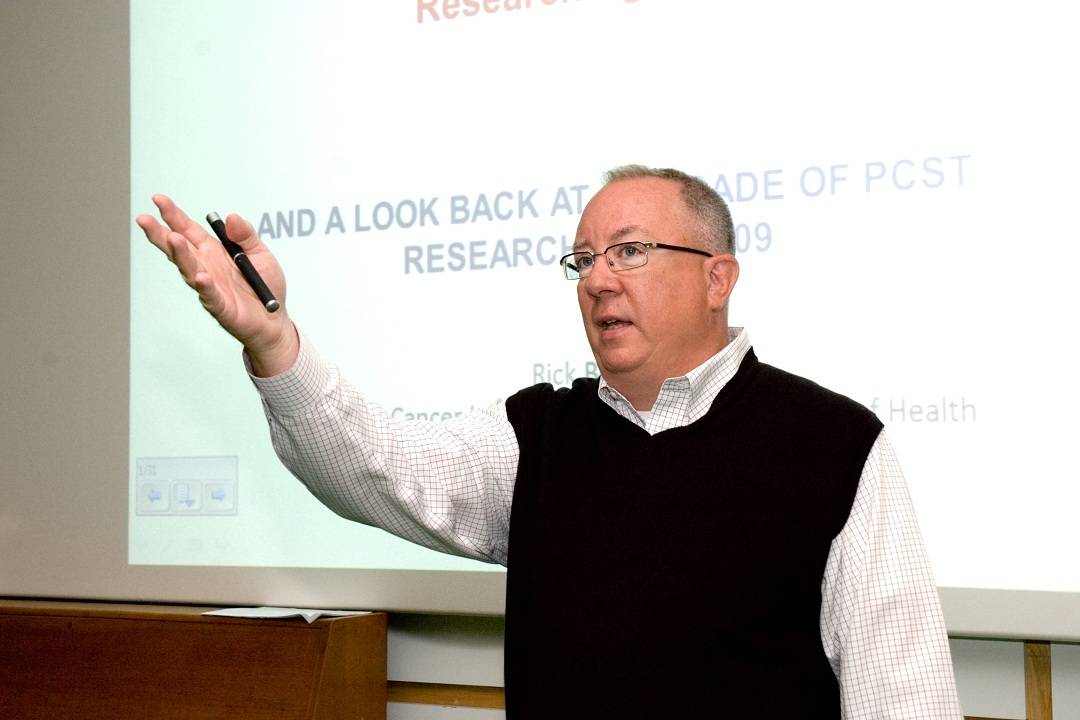
The blog reports on a public lecture by Rick Borchelt held on Friday, 15 June at the University of Nottingham.
Rick is Special Assistant for Public Affairs to the Director of the National Cancer Institute at the US National Institutes of Health. He has also held many other posts including that of Special Assistant for Public Affairs in Science and Technology in the Executive Office of The President during the Clinton Administration.
Crikey.
Rick began his lecture by describing how he had started his PhD with an interest in spiders, which went well for about two months until the supervisor died. The college then gave Rick a project on butterflies because that was what the college had funding for. Although perhaps less fun, this muddled along for about two months until the supervisor died. If there is one thing that scientists can do well, it is to spot a trend – and the staff could clearly see that becoming Rick’s supervisor was potentially a life threatening move. So they gave Rick the project of someone who was already dead. This was a project on microlepidoptera, months only a few millimetres in size who spend their caterpillar days munching away between the top and bottom surfaces of a leaf. You can find some information on them h ere, here and a paper with some groovy SEM imagery here. .
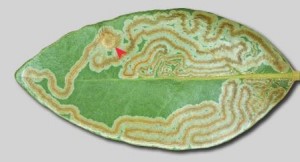
Leaf mines by Phyllocnistis hyperpersea on Persea borbonia. The red arrow indicates the pupal crypt.
As part of the project, Rick found himself spending the summer at the Smithsonian Museum moving microlepidoptera from box to box in a small humid room high in the building. The location of the room meant that Rick could hear many of the conversations that were happening in the museum as they echoed up through the ventilation tubes. At 2pm there would be a huge increase in noise as all the kids piled into the insect section to watch the tarantulas being fed mice and Rick noticed that the children were asking some very deep questions. Why did spiders have eight legs? Why were only some venoms poisonous to humans? Why? Why? Why? But the conversations coming up from the head of the insect department were very different. They were about the minutiae of how a particular insect should be classified. Rick noted the huge discrepancy between what the scientists and the public were saying. He also noticed that, as things stood, his career appears to one involving years of detailed inspection of moths.
So Rick decided that perhaps he was not in quite the right career after all and enrolled on a journalism and science writing course. Eventually, this took him to the giddy heights of the West Wing of the White House, and Rick was kind enough to answer the question that everyone was thinking “Is the real West Wing the same as the TV West Wing”. Mostly, no, it isn’t. Unlike the TV version, the real West Wing has some rather dodgy décor, with wires hanging from the odd ceiling, and some somewhat manky carpets. Nor are the conversations in the real West Wing as erudite as those on the TV. But there is one way thing that both the real and TV West Wings share – science advisors are never seen in either one. Rick pointed out that, as far as politicians are concerned, the answer to the question “Is there a role for science in defining policy?” is “not if you want to get re-elected”.
How do people react to images of scientists?
The talk then moved on to discuss the work that Rick had undertaken to evaluate whether PCST (Public Communication of Science and Technology) was really a valid field of study in its own right. Happily for both you the reader and NSB (Nottingham Science Blog), some slides of a very similar talk by Rick can be found here, and are certainly worth having a look at.
How do people react to images of surgeons?

- Why don’t turtles, one of the oldest species on earth, ever get cancer? Nobody knows.
- Why are obese people more likely to get cancer? Nobody knows.
and mentioned that work was ongoing to build deep community engagement projects using “provocative questions” such as these. He suggested that PCST practitioners should work “in the valleys” between the popular questions to investigate topics that will genuinely develop the field. After the talk, NSB asked Rick what he felt were some of the barriers to people who were interested in science and wanted to find out more about a topic or story they had seen in the media. Rick responded by saying that it was certainly a problem that media organisations often did not give links for people to the original research (which was something he tried to do when publishing material) but that one could often find out more by contacting the university that had performed the research. NSB has to point out that the fact that a set of slides of the talk (or at least one very similar) has made the blog post that you are reading more accurate and also saved several hours in its preparation. On the other hand, could NSB find a biog or home page for Rick at the National Cancer Institute? No siree, it could not. So perhaps a bit of “accessibility” work needed there (smiley face!!)
How do people react to schematics of chemicals (Vitamin C in this case)?
Rating on the NSB Science Accessibility Criteria
.

The talk has provoked NSB into setting up a list of actions that it would like to see presenting organisations follow. Hopefully, they are items that make it easy to follow up on a talk and find out more information. So here goes :
1) Does the organisation have a central list of all events? No
2) It is clear, before the talk starts , whether the slides will be available on the Internet or by email?No
3) Are links provided for people to find out more information?Yes
4) Are papers that are referred easily accessible, in full, to the public?Not checked
NB: Thanks to Sons No1 and 2 for providing input to some of the questions on the criteria.
Image Sources Wikipedia, Scientists, Surgeons