Public engagement with ‘post-normal science’
March 26, 2021, by Brigitte Nerlich
Public engagement with ‘post-normal science’
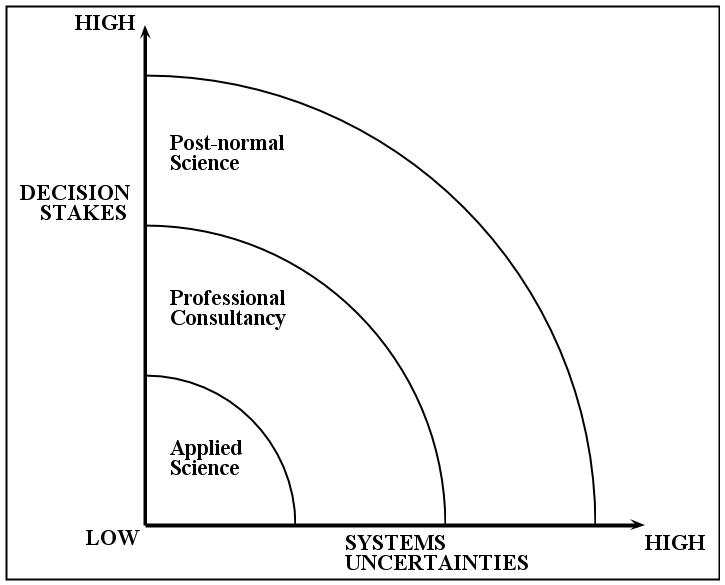
Post-normal science
What is post-normal science? It is a difficult concept, especially as words like ‘post’, ‘normal’ and ‘science’ are themselves difficult.
Sometimes the ‘science’ bit is descriptive, as when the article says that post-normal science “describes the kind of science that takes place in conditions of great uncertainty, where the values around science are in dispute, the stakes are high and decisions are urgent”. Science in times of covid is described as post-normal science “on steroids” and as “more vulnerable to bad science”.
More often though, the ‘science’ bit seems to refer to a method, a framework, a strategy or “a novel approach for the use of science on issues where ‘facts [are] uncertain, values in dispute, stakes high and decisions urgent’” ( Wikipedia ). It’s basically about improving science advice in difficult times. It should perhaps have been called post-normal science politics.
Three key propositions in the article were picked up by readers, mostly rather hostile to the concept of post-normal science or PNS.
‘Normal science tells us what to do’
The first proposition is based on a picture of normal science implicitly painted by those proposing PNS: “The scientists do the science. Then they tell the rest of us what to do, and lives get saved”.
Another reader points out: “I think that this article may be confusing two different things. On the one hand there are policy decisions based on scientific input. On the other hand there is the scientific method. In a new field of endeavor with a global impact, the need to make policy decisions will accelerate ahead of what the scientific method can deliver in the short term. ”
‘Normal science is pure’
‘Post-normal science boosts bias’
A third proposition highlighted by readers was: “The high-stakes, highly uncertain nature of post-normal science also paves the way for scientists’ own bias to creep in. ” Here we are dealing with an aspect of PNS as such, not with underlying conceptions of normal science.
Post-normal science, for and against
“I can’t say I’ve heard of ‘post-normal science’ but it seems to be journalese for research carried out under intense time pressure. The wonder is that, under these conditions, science comes up with pretty good solutions and that safeguards such as peer review hold up as well as they do. ”
“It appears to me that there is little very new in the term ‘post-normal science’. It seems to be just a new way of describing an area of study within a highly visible topic of great concern, about which not a very good scientific understanding or model has been established. ”
“Post-normal? Science is always like this. [….] ‘Cutting-edge’ science is generally open to multiple interpretations, there are always mavericks with ideas some way away from the consensus, sometimes they’re right, often they’re wrong. Experiments get repeated and don’t work the same way the second time, or in other hands, because the world is complicated. Normally it’s the science that is more mature and less controversial that is used to inform debate and drive the development of new technologies. In the pandemic however, hot-from-the-bench science has been of the upmost importance, but it is also vulnerable to misrepresentation and misuse. ”
“It might seem odd to be talking about weaknesses in science when it has delivered us several effective vaccines against Covid in just a year. […] not a mention in the article about the scientists who have delivered these vaccines. Ugur Sahin, Sarah Gilbert and others. The scientists who developed the concept of messenger RNA vaccines. Katalin Kariko, Drew Weissman and others. They have no political angle. Their motivation is scientific discovery and saving lives. ”
Conclusion
Overall then, having read Sonia Sodha’s article, readers struggled with the notion of PNS, or rather not so much with the notion of PNS but with the implicit assumptions being made about normal science inherent in the notion of PNS. This might be something for PNS researchers to reflect on when trying to engage publics with that concept, especially since the implicit portrayal of normal science as something that it is not, or of normal scientists as doing something they generally do not, permeates much of PNS writing. I’ll provide just one example:
“Normal Science has demonstrated great power in identifying viral structures, attachment sites, and pathogenic mechanisms. All these are essential for medical diagnostic and treatment regimes. However, to answer questions related to managing these technologies, including setting priorities when, for instance, respirators and hospital beds reach their limit, and for identifying how to reorganize institutional structures, Normal Science offers no guidance at all. ”
A final thought: I wonder why Normal Science was successful in providing guidance regarding pandemic management in Australia, New Zealand, Taiwan, South Korea, Vietnam and Japan, for example, but not in the UK and, until recently, the US, despite sharing a world where facts are uncertain, stakes high and decisions urgent. Is it that in these parts of the world values were not in dispute?
Notes
*Since around 1996 PNS has only been mentioned about 40 times in mainstream newspapers, mainly during the time of climategate.
**This programme showed that scientific peer review and, in a sense, peer pressure are accepted by some scientists but that others resist it.
Image: Wikipedia