Is STS trivial? Chris Toumey reflects on writing a book about nanotech and the humanities
February 15, 2019, by Brigitte Nerlich
Is STS trivial? Chris Toumey reflects on writing a book about nanotech and the humanities
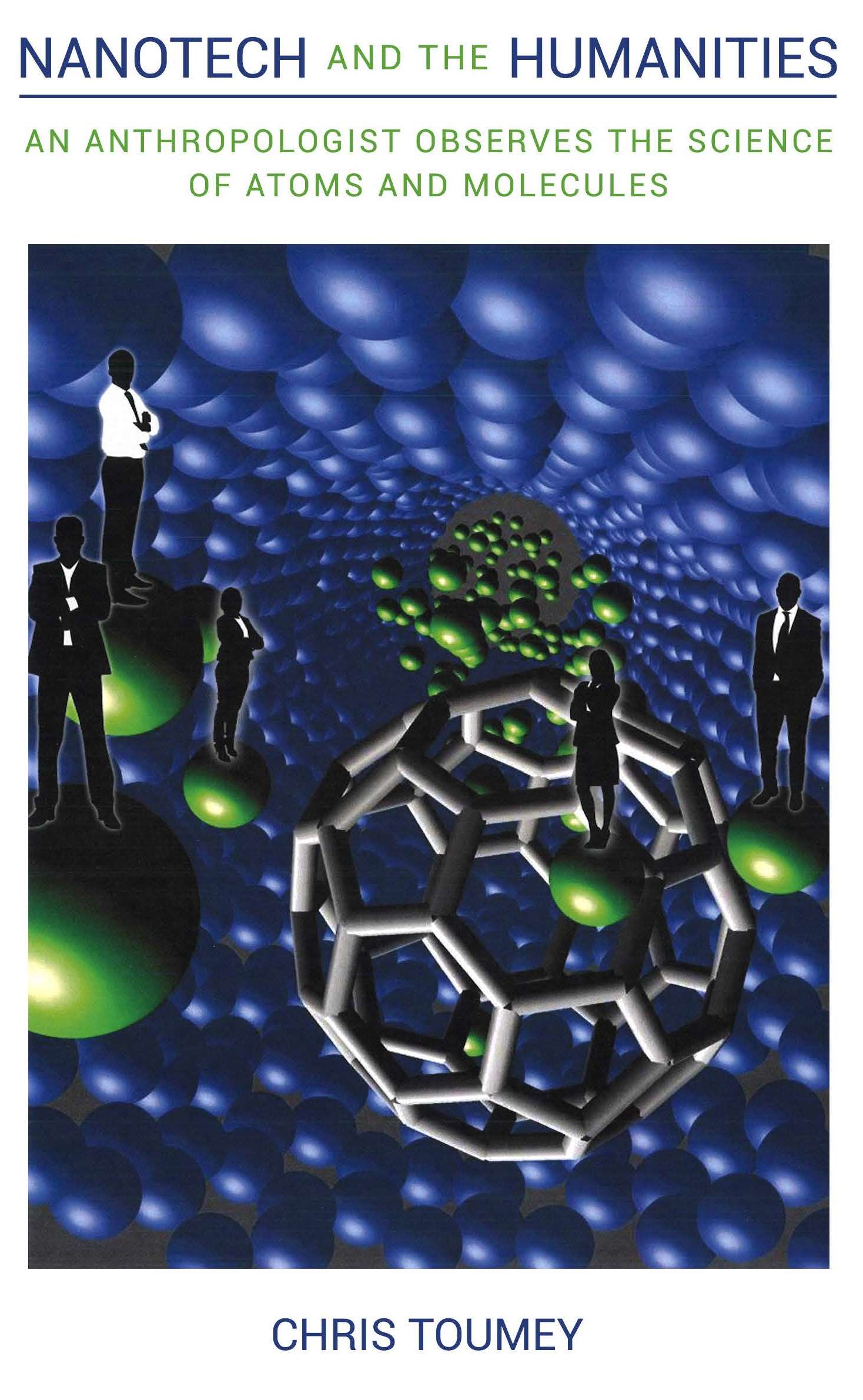
This is a guest post by Chris Toumey, a cultural anthropologist who has observed and studied developments in nanotechnology for many years. Chris and I have known each other for a long time, and his work and words have always inspired me. He has just published a book entitled Nanotech and the Humanities: An Anthropologist Observes the Science of Atoms and Molecules. In this post he reflects on his writing and its relation to Science and Technology Studies (STS). I’ll follow up these thoughts with my own about what I have called ‘responsible writing’. Chris’s book is part of a new STS genre of which Andrew Maynard’s Films from the Future, featured in this blog post, is another example.
Is STS trivial?
The field of STS has a cloud above its head, namely, the question of whether our work is trivial. If our research and writing cause others to better understand science and technology, then our work is worthwhile. We do not need to formulate hypotheses about cause-and-effect relationships in the natural world, let alone conduct experiments to test hypotheses. That we can leave to our friends in science and engineering. Our contribution is to enrich our readers’ understandings of science and technology by elucidating the historical circumstances from which science and technology emerge; or to show how social forces shape them; or to identify cultural dynamics which steer science and technology in one direction, and not another.
But our work is trivial if the international STS community consists of philosophers speaking only with other philosophers; or some philosophers interacting only with some historians; or a small number of philosophers and historians communicating only with a small number of professors of literature; and so on.
In other words, our work is nontrivial if our insights are helpful to others, whether scientists, engineers, or laypersons, as they hope to better understand science and technology. But we consign ourselves to trivial work if we are a community of scholars in the humanities and social sciences who communicate only with each other.
This is how I hope that Nanotechnology and the Humanities will be appreciated. If some of us in STS have enriched others’ understandings of nanotechnology, and especially if my book reaches readers beyond the STS community, then I have shown that our research and writing have escaped the trap of trivial scholarship. We do not limit ourselves to communicating only with like-minded colleagues, but we see that many persons’ understandings of science and technology can benefit from the perspectives of the humanities and social sciences which we call Science & Technology Studies.
Afterword/foreword
Chris mentions the foreword to the book which I (Brigitte) wrote a while ago. Having totally forgotten what I wrote, I was surprised to find the following bit of text which I think is worth repeating. But before I do so, I just want to say: writing well and writing non-trivially for a wide range of people is not easy. It can be quite hard work! So I am grateful to people like Chris who put in this work.
“At a time when we hear more and more about ‘responsible research and innovation’, I think it is time to reflect on what one may call responsible academic writing and responsible language use. Here I echo Chris Toumey’s words: those of us, especially in what is called Science & Technology Studies, where we use the humanities and social sciences to better understand nanoscience and nanotechnology, have a responsibility to share our work with the very scientists and engineers that make nanotechnology happen, as well as with as large an audience as possible of non-specialists who care very much about science, technology and their societal issues. This means writing in order to be understood rather than writing to show off how clever we are. The chapters for this book accomplish these tasks brilliantly. They are readable, understandable, enjoyable, but nonetheless profound. They are great examples of responsible research and writing.