Epigenetics, hype and harm
June 3, 2016, by Brigitte Nerlich

Epigenetics, hype and harm
I first became interested in epigenetics in around 2010/2011. I know this because I trawled my emails and found a link that I had sent myself on 11 February 2011 to an article in Mother Jones entitled “ The illustrated guide to epigenetics ”. The first paragraph of this guide is rather prophetic: “This month marks the ten-year anniversary of the sequencing of the human genome, that noble achievement underpinning the less noble sales of 23andMe ‘s direct-to-consumer genetic tests. To commemorate the scientific occasion, we’ve created an illustrated introduction to one subfield of genetics likely to produce even more dubious novelty science projects someday: epigenetics. ” (italics added) This is exactly what happened and what I’ll reflect upon in this post. But what is epigenetics?
Epigenetics
Definitions of epigenetics are rather varied and contested, but I’ll go with this one: “Epigenetics explores chemical tags on DNA that have the ability to turn genes on or off…. What intrigues many people about the study of epigenetics is the idea that environmental aspects or an individual’s lifestyle may influence these chemical tags and, therefore, impact how our genes express themselves… Perhaps even more intriguing is the discovery that certain epigenetic marks may be maintained and passed on through generations, known as transgenerational epigenetic inheritance. ”
Speculations triggered by such intriguing discoveries led to disputes about what some saw as a ‘ crisis ’ in evolutionary theory, a return of Lamarckism and/or a return of eugenic thinking. On a more peaceful level, there were calls for closer collaborations between biologists and sociologists – a call eagerly taken up by sociologists keen to ‘ revitalise ‘ sociology. And finally, as epigenetics seemed to turn the tables on so-called ‘genetic determinism’ and focused attention on the ‘environment’ (in whatever form), policy makers began to dream about a ‘scientific’ way of dealing with anything from health to poverty and to ask: “Can we use epigenetic information to understand and prevent human disease through environmental modifications (reducing exposures, dietary changes and medication use)?”
Epi-hype
Between 2010 and 2012 I began to read more and more about epigenetics in newspapers, academic articles, and on alternative health websites peddling what I began to call ‘epi-woo’ – others call it flapdoodle. But despite my doubts, I almost got sucked into an emerging cycle of natural and social science hype about epigenetic hopes and fears. In 2013 I wrote a slightly breathless blog post about epigenetics, but I fortunately ended on a cautious note and said: “We have learned many lessons about how quickly scientific advances in, say, cloning, stem cell research or neuroscience can be overhyped (both positively and negatively, in terms of hopes and fears). While studying epigenetics from a social science perspective, we should try not to contribute to this emerging hype. While observing and watching over the emerging science, we should also pay attention to how its results are transformed (and perhaps overinterpreted) in various societal and political projects. ” (For a more detailed discussion of the “political implications of the emerging science of epigenetics in specific policy domains”, read Shea Robison’s forthcoming book on the topic)
Hype monitoring
In the same year, 2013, Edith Heard, a Professor at the Collège de France, holding the Chair of Epigenetics and Cellular Memory, tried to reign in some of the emerging hype. In an article for The Guardian she is quoted as saying: “’Even our epigenetic changes are genetically driven. The code of genetics is the code. It’s the only code. ’ But now with epigenetics, ‘people are hoping we can pray our way out of faulty genes’…. ‘It’s our duty as scientists to pass on the right messages. I don’t want to say epigenetics isn’t exciting … [but] there’s a gap between the fact and the fantasy. Now the facts are having to catch up’.” This realistic view of epigenetics didn’t quite stop the hype. In fact, by 2014 epigenetics was, according to Judith Shulevitz, “fast becoming the top topic in pop science”, and, I would add, in pop social science and pop social policy.
Waves of natural and social science hype are still splashing onto the shores of twitter now in 2016, sometimes broken by boulders declaring #epibollocks (and neurobollocks ). It is actually quite heartening to see how blogs and tweets have become a normal part of peer review and are also used to monitor emerging hype. This became particularly apparent recently when bloggers and tweeters scrutinised a popular science article by Siddhartha Mukherjee about epigenetics written for the New Yorker (published 2 May) and then an article on epigenetics, depression and poverty published in Molecular Psychiatry on 24 May.
This doesn’t mean that ‘normal’ academic articles don’t contribute to this process of hype monitoring as well. An article published in 2015 for example is entitled “ Neural and behavioral epigenetics; what it is, and what is hype ” and says: “some of this research has also attracted controversy and … some overblown claims. This latter problem is partly linked to the shifting sands of what is defined as ‘epigenetics’.” Martyn Pickersgill, an expert in social studies of biomedicine, published an article in 2016 in which he studied efforts by natural scientists practicing epigenetics to engage in ‘epistemic modesty’ and to guard against ‘epistemic ostentatiousness’ and hype.
Hype and harm
It is rather worrying to see how hype has begun to devalue the concept of ‘epigenetics’. This might harm the real and fascinating study of gene regulation and related topics, as well as the public understanding of and public engagement with these topics.
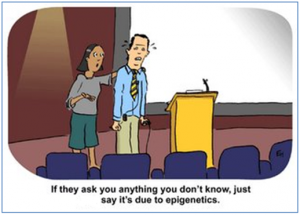
I close with a cartoon displayed within a blog post by Caroline Relton for the OUPblog on epigenetics and epidemiology, which sort of sums up the current situation:
Image: DNA methylation, wikimedia commons