Do online user comments provide a space for deliberative democracy?
October 11, 2013, by Brigitte Nerlich

This is a guest post by Luke Collins who is working with Brigitte Nerlich on an ESRC funded project dealing with climate change as a complex social issue. Yesterday, he gave talk about his research to an interdisciplinary audience attending the Institute for Science and Society/STS PG seminar series.
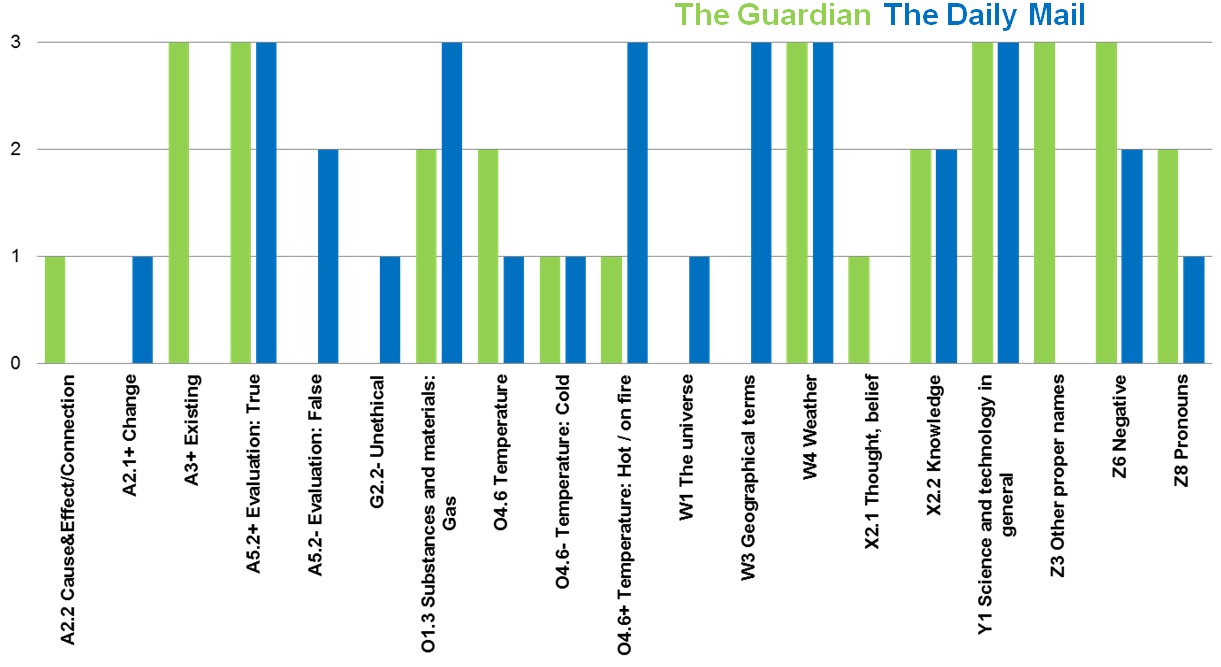
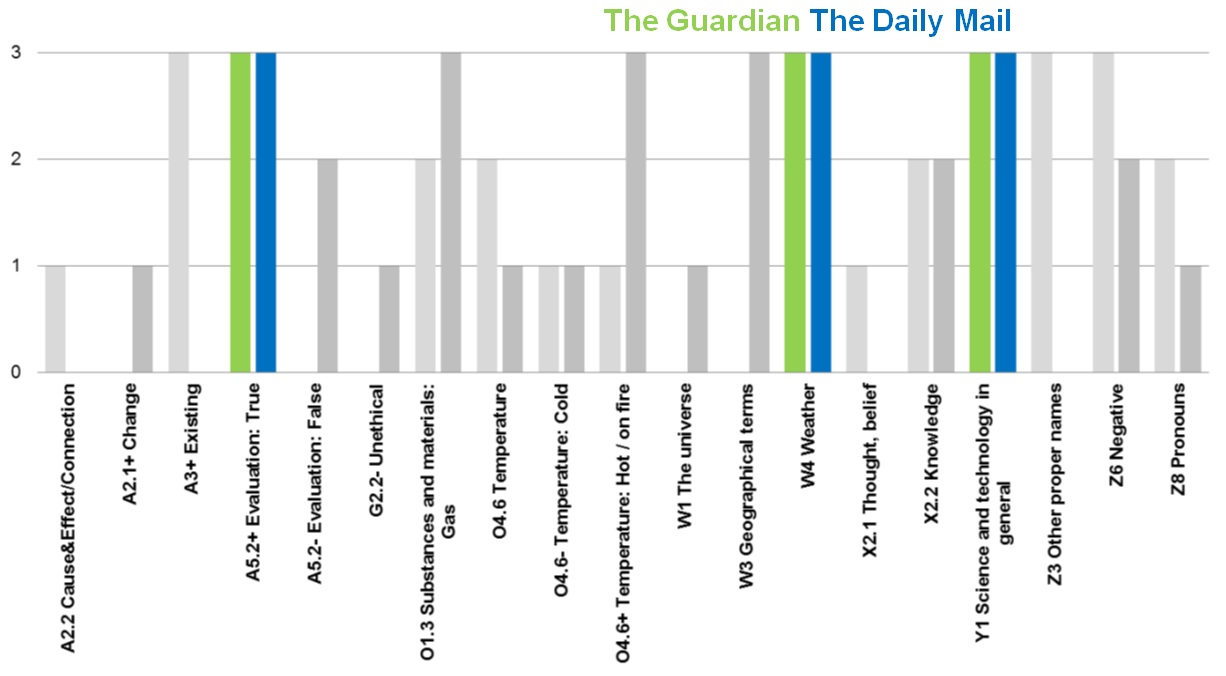
In all three discussion threads from The Guardian and all three from The Daily Mail the categories of ‘Evaluation: True’ (incorporating words such as ‘proof’, ‘evidence’, ‘fact’, ‘truth’); ‘Weather’ (words such as ‘climate’, ‘weather’, ‘snow’, ‘wind’); and ‘Science and technology in general’ (‘science’; ‘scientific’; ‘thermodynamics’) were prominent:
Those categories that were prominent only in the discussion threads taken from The Daily Mail were ‘Substances and materials: Gas’, which largely consisted of references to CO2; ‘Geographical terms’ and ‘Temperature: Hot/On Fire’, which together accounted for frequent use of the term ‘global warming’; and ‘Evaluation: False’, which in contrast to the category incorporating words of ‘truth’, ‘proof’ and ‘evidence’, was made up of terms such as ‘lies’, ‘hoax’, ‘false’, ‘deception’ and ‘misleading’. This category was not as prominent in the discussion threads taken from The Guardian.
Users
‘Dialogic expansion’ and ‘dialogic contraction’
To examine the potential for deliberative and democratic engagement we can refer to the language of intersubjective stance and the ways in which individuals invite or inhibit deliberation through aspects of their discourse. We can refer to ‘ heteroglossic engagement’ which describes utterances which engage with dialogic alternatives. Recognising that individuals communicate their stance – or their association around a particular idea or principle – through discourse we can distinguish between the strength with which they associate themselves with that idea (modality) and the potential for alternative ideas to be considered. At one end of the spectrum we find the bare assertion: the statement as if ‘fact’ that makes a simple claim in simple terms. More often however, utterances consist of discursive features that – to some degree or another – recognise that the statement exists amongst a multitude of alternative positions. Within the ‘heteroglossic’ there are those linguistic resources which are seen to be ‘dialogically contractive’ and those which are ‘dialogically expansive’.
Whether a statement is ‘dialogically contractive’ or ‘dialogically expansive’ is largely determined by stance indicators, including modal verbs ‘can/could’, ‘may/might/must’, ‘shall/should’ and ‘will/would’. We can see how the more uncertain terms, ‘may’, ‘could’, ‘might’ more effectively encourage the consideration of alternatives than the assertive ‘will’, ‘shall’, ‘should’. The use of modal verbs in this way not only indicates the individual’s attachment to a particular stance and the potential to ally themselves to new alternatives, but also welcomes alternative voices or propositions from other interlocutors.
A statement such as ‘if it could be proven that’ is speculative, it entertains an idea and as such sets a precedent for other contributors to discuss in terms of possibilities. This kind of expansion is necessary for the introduction and development of new ideas, of alternative viewpoints and for learning.