Addressing the leaky pipeline- how can we retain and develop women in Biosciences
May 27, 2018, by Simon Langley-Evans
Addressing the leaky pipeline- how can we retain and develop women in Biosciences
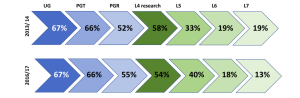
The analogy of a leaky pipeline is often used when discussing the loss of highly talented women from the Higher Education environment. In virtually every science, technology and mathematics department in the UK the story is always the same, with the proportion of women at each level in the academic hierarchy getting progressively smaller. The School of Biosciences at Nottingham is now different, as shown in the diagram.
The chart shows the proportion of women at each level in the School of Biosciences, comparing 2013/14 with 2016/17. We have more women doing research degrees and working as lecturers (level 5) than in the past, but the small numbers of professors (level 7) is very frustrating.
We teach disciplines that are generally more popular with women than with men and so our intake of undergraduate and taught postgraduate students is approximately two-thirds female, but then things start to change. Fewer women study with us to PhD level and join us as research assistants and postdocs (level 4 staff) and by the time we look at staff joining us at level 5 (lecturer/assistant professor), we are down to 40% women. From there, the numbers fall dramatically and the slight leak in our pipeline becomes a gushing torrent. At level 6 (senior lecturer/associate professor) we are down to 18% and at level 7 (professor), a meagre 13% are women. This leaky pipeline is all about attrition and analysing it gives us some disturbing messages:
- Women are less attracted to higher level (PhD study). This is not about lack of ability- there is something about doing a PhD and following an academic route that is unappealing to women.
- Attrition among women who complete a PhD is at a horrendous level. Women are significantly less likely to progress from a postdoc position to a tenured post and move up the academic levels at a much slower rate than men do.
I am bitterly disappointed to see this in our School. We consider ourselves to be among the good guys, committed to equality and diversity, but we are falling short and need to take a good hard look at what we are doing.
It has been suggested that women leave STEM subject areas in academia for many reasons including a greater tendency to burn out; because they are discriminated against in appointment processes; because they are less likely to be supported in promotion processes; and because societal norms about raising families mean that women are far more likely to take career breaks and key transitional points in their academic working lives than men are. The University of Nottingham’s Vice Chancellor, Professor Shearer West has reflected on these issues in a number of articles, and speaks about a negative sense of victimhood that can also play a part in undermining women’s confidence in pushing for higher level academic careers.
As Head of School in Biosciences, I am absolutely committed to seeing more women in higher posts in the School and to bringing more women into leadership positions. I was really delighted earlier this year when Professor Debbie Sparkes agreed to become Head of Division of Agricultural and Environmental Sciences, our first female HoD for several years. Achieving change is going to take some time. Academic posts, particularly at higher levels, don’t become available very often and so rectifying the imbalance by recruiting more women directly is not a practical solution. Instead we need to be thinking about attracting more women into academia at the lower levels and then ensuring that they have excellent development opportunities and rapid progression through promotion.
In the School of Biosciences, we have recognised that we have a problem with recruiting and retaining women in academic posts, but we have a cunning plan to address this:
- Fair appointments. We are implementing changes that will ensure that both women and men are on interview panels for posts within the School and will challenge where this is not the case. It is also our expectation that all staff have completed some training on unconscious bias before being involved in job short-listing and interviewing.
- Role models for our current and prospective students. The process through which women become disillusioned with science and the academic process begins early. We can see it in our figures that show attrition between undergraduate and postgraduate study. We are promoting women in science subject areas through use of appropriate imagery in our prospectus, having women as admissions tutors, and by having women present about their lives and work in science at careers fairs for our students.
- Women Fellows. The University of Nottingham has some incredibly attractive Fellowship schemes to help talented researchers get on to the permanently funded academic ladder. Nottingham Research Fellowships and Ann MacLaren (women only) Fellowships give 3 years support and lead on to a permanent lectureship. In the School at the moment we have 7 fellows on these and similar schemes, and 5 of these are women.
- Inspiringwomen to succeed. We are taking a number of actions to give a higher profile to women who have been successful in academia as researchers, teachers and administrators. Our hope is that this will give these role models a higher profile in the School and inspire women at the start of their careers to progress. Actions include our Women in Biosciences campaign and Redressing the Balance seminars (which have included former Deputy VC and now VC at the University of Kent, Karen Cox and in November will feature Shearer West).
- Retention through family friendly policies. Many people need to be able to work flexibly to accommodate childcare and other caring responsibilities. We have implemented a flexible working policy which enables colleagues to a) request flexible start and finish times for the working day (short- or long-term, or permanent arrangements); b) work flexibly to accommodate occasional appointments or caring responsibilities; and c) be absent from work during core hours if there has been a requirement to work weekends, or into the evening. Flexible working is fully supported by senior management and many staff are able to work from home, if they have no teaching or other commitments that require them to be present on site, and are able to manage their own working hours.
- Promotion. Actions we have taken to encourage and support colleagues with promotion have been very successful in helping women move from level 4 (teaching associates) to level 5 (assistant professor) and to level 6 (associate professor). I have advertised and run annual promotions workshops since 2012 to develop this. Since the inception of promotions workshops, applications have increased from an average 5 to 8 per year (men) and 2 to 5 per year (women). Recent promotion rounds have seen 100% success for women and this has increased the proportion of women at level 5 since 2014.
In this process we are finding that we are continually taking two steps forward and one step back. The successful outcomes for some women are that they take up more senior posts at a different institution or even outside academia. Successful careers are also rewarded with the joy of retirement and so, as we promote more women to professor, we have a corresponding loss that knocks back the gains we make.
The equality of opportunity that we have built into the rapidly evolving culture of our School should mean that the balance of academic staff in the School represents the proportions of women who enter the discipline at the bottom. My aspiration is therefore that one day, more than 50% of the professors in the School are women. I am a realist though and realise that this aspiration will not be achieved within my working lifetime. For now, the goal is to lay the foundations for a future revolution in the staffing of the School.