50 at 50: PINCER – transforming healthcare
February 19, 2021, by School of Medicine

50 at 50: PINCER – transforming healthcare
Medication errors in general practice are an important and expensive preventable cause of patient safety incidents associated with morbidity, hospitalisations and deaths. PINCER is a pharmacist-led, IT-based intervention to reduce clinically important medication errors in primary care and was developed and tested by researchers at the Universities of Manchester and Nottingham, led by Prof Tony Avery and Dr Sarah Rodgers.
The intervention involves searching GP clinical systems using computerised prescribing safety indicators to identify patients at risk from their medications and then acting to correct any problems with pharmacist support.
The effectiveness of the PINCER intervention was shown in a cluster randomised trial which was published in the Lancet in 2012. Following the trial, with funding obtained from the Health Foundation and East Midlands Academic Health Science Network, PINCER was rolled out to 370 general practices across 12 East Midlands Clinical Commissioning Groups (CCGs) between September 2015 and April 2017. Over 21,000 instances of hazardous prescribing were identified in a patient population of just over 2.9 million people. Findings from this project showed that the rollout was effective and demonstrated statistically significant reductions in hazardous prescribing (particularly for preventing gastrointestinal (GI) bleed).
Having obtained further funding from the Health Foundation, PRIMIS (which is part of the School of Medicine and is currently celebrating its own 20th anniversary) have worked with Spring Impact, a non-profit global leader in social replication to design a replication model for the scale and spread of PINCER using a social franchise approach. This involves enabling another team or organisation to deliver a proven intervention to agreed standards under a franchise agreement, with the primary aim of maximising social benefit. Since 2018, PRIMIS has been working with all 15 Academic Health Science Networks (AHSNs) in England to implement PINCER within their localities, with the University of Nottingham acting as “Franchisor” and the 15 AHSNs in England acting as “Franchisees”.
- The replication model provides AHSNs with everything that they need for the successful implementation of PINCER including: Training and support services for AHSNs and CCGs (three Action Learning Sets and supporting resources have been developed by PRIMIS and are delivered by PRIMIS and/or PRIMIS approved Training Associates to enable pharmacists to implement PINCER in their locality)
- Access to the national PINCER prescribing safety indicators (maintained by PRIMIS) and evidence-based summaries for each indicator
- Access to a comparative analysis service (PRIMIS’ “CHART Online”)
- Tools to support reporting requirements and metrics
- National communication and promotion
As part of the national rollout, information on numbers of patients at risk of potentially hazardous prescribing based on the 13 PINCER prescribing safety indicators has contributed to a national comparative data service (CHART Online). This has provided the ability to monitor changes in numbers of at-risk patients across localities and on a national basis.
As of September 2020, the scale and scope of the national rollout of PINCER has reached:
- Over 2,500 GP practices
- 103 CCGs
- 24.55m individual patient records searched
- 196,632 at-risk patients identified in at least one indicator
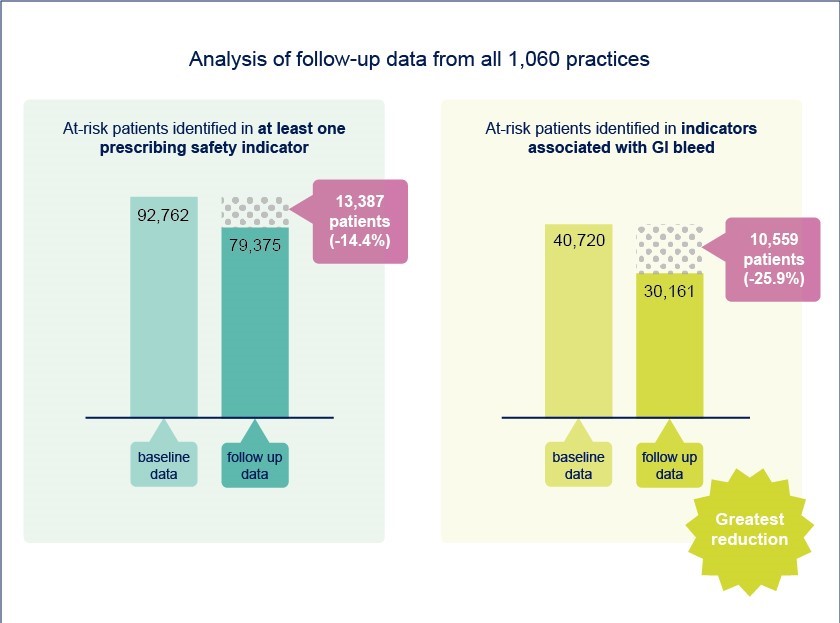
- 13,387 (-14.4%) fewer patients at risk of medication error (of the 1,060 GP practices that have uploaded follow-up data)
- Greatest reductions for those indicators associated with GI bleed (10,559 fewer patients at risk, -25.9%)
- 1,600+ individuals trained in the PINCER intervention
A progress report on the national rollout of PINCER (published in September 2020) can be accessed by visiting the PRIMIS PINCER webpage.
Infographic from the PINCER Progress Report, showing improvements in the reductions of numbers of at-risk patients (using follow-up data from 1,060 practices):
PRIMIS and the AHSN Network are delighted to have been shortlisted for Patient Safety Team of the Year at this year’s HSJ Patient Safety Awards, recognising their outstanding contribution to healthcare through the national rollout of PINCER.

Find out more about the HSJ Patient Safety Awards
PRIMIS is currently working with colleagues from the University of Nottingham to find out whether the PINCER intervention has prevented serious harm to patients, including hospital admissions. This follow-on study (called PRoTeCT) involves a more detailed analysis of data from GP practices in the East Midlands. For further information, please visit PRoTeCT Study.